
When people ask who the most famous Indian English poet is, the answer isn’t just a name-it’s a legacy. One name rises above all others, not because of awards or trends, but because their words changed how the world saw Indian thought, emotion, and spirit in English. That name is Rabindranath Tagore.
Why Tagore Stands Alone
Tagore didn’t just write poetry in English-he redefined what Indian poetry could be on a global stage. He won the Nobel Prize in Literature in 1913, the first non-European to do so, for his collection Gitanjali (Song Offerings). The book wasn’t originally written in English. It was a self-translated selection of his Bengali poems, rendered into lyrical, spiritual English prose that felt both ancient and fresh to Western readers.
His poems didn’t follow Victorian rhyme schemes or Romantic flourishes. They were quiet. They breathed. They spoke of nature, God, loss, and the soul in a way that felt intimate, like a whisper in a temple courtyard at dawn. Lines like, "You have made me endless, such is your pleasure," or "Let me not pray to be sheltered from dangers, but to be fearless in facing them," weren’t just poetic-they became mantras for people across continents.
Tagore’s fame wasn’t limited to poetry. He composed India’s national anthem, Jana Gana Mana, and Bangladesh’s, Amar Shonar Bangla. He founded Visva-Bharati University in Santiniketan, blending art, nature, and learning. But it’s his English poetry that reached farthest. By 1920, his works were being read in London salons, New York libraries, and Tokyo classrooms. No other Indian poet writing in English has matched that global footprint.
Other Names Often Mentioned-But Why They Don’t Compare
People sometimes bring up Sarojini Naidu, A.K. Ramanujan, or Nissim Ezekiel. Each is important. Each deserves respect. But none reached the same level of international recognition or cultural impact.
Sarojini Naidu, the "Nightingale of India," wrote beautiful, musical poems in English. Her work, like The Golden Threshold, dazzled with color and rhythm. But her themes were mostly lyrical-love, beauty, nature. She didn’t challenge spiritual or philosophical norms the way Tagore did. Her fame stayed mostly regional, admired in India and the British literary circles of her time, but never exploded globally.
A.K. Ramanujan was a scholar and poet who blended South Indian folklore with modernist English. His poems were sharp, layered, and deeply Indian in texture. But his audience was academic. His work is studied in universities, not quoted in homes. He wrote for readers who already knew the context. Tagore wrote for anyone, anywhere.
Nissim Ezekiel brought a new voice-dry, ironic, urban. He gave Indian English poetry a modern, urban edge with poems like Night of the Scorpion. But his influence was more about style than scale. He helped Indian poetry find its contemporary voice, but he didn’t redefine its soul.
Tagore’s work transcends style. It’s not about technique. It’s about presence. His poems feel like they’ve always existed, waiting to be heard.
What Made His English Poetry So Powerful
Tagore didn’t write English like a colonized student trying to please his teacher. He wrote it like a man who had mastered the language, then used it to speak his own truth. His translations weren’t literal. They were re-creations. He stripped away ornamentation. He let silence speak. He turned complex spiritual ideas into simple, haunting lines.
Compare this to poets who wrote in English but still clung to European metaphors-trees as symbols of nobility, rivers as metaphors for time in a Romantic way. Tagore’s trees were banyans. His rivers were the Ganges and the Padma. His God wasn’t a distant king in heaven-he was in the breeze, in the child’s laughter, in the silence between heartbeats.
His English poems work because they’re not trying to be Western. They’re Indian, deeply and unapologetically so, but expressed in a language the world understood. That’s rare. Most writers either assimilate or resist. Tagore did both-he embraced the language, then filled it with his own world.
His Legacy Today
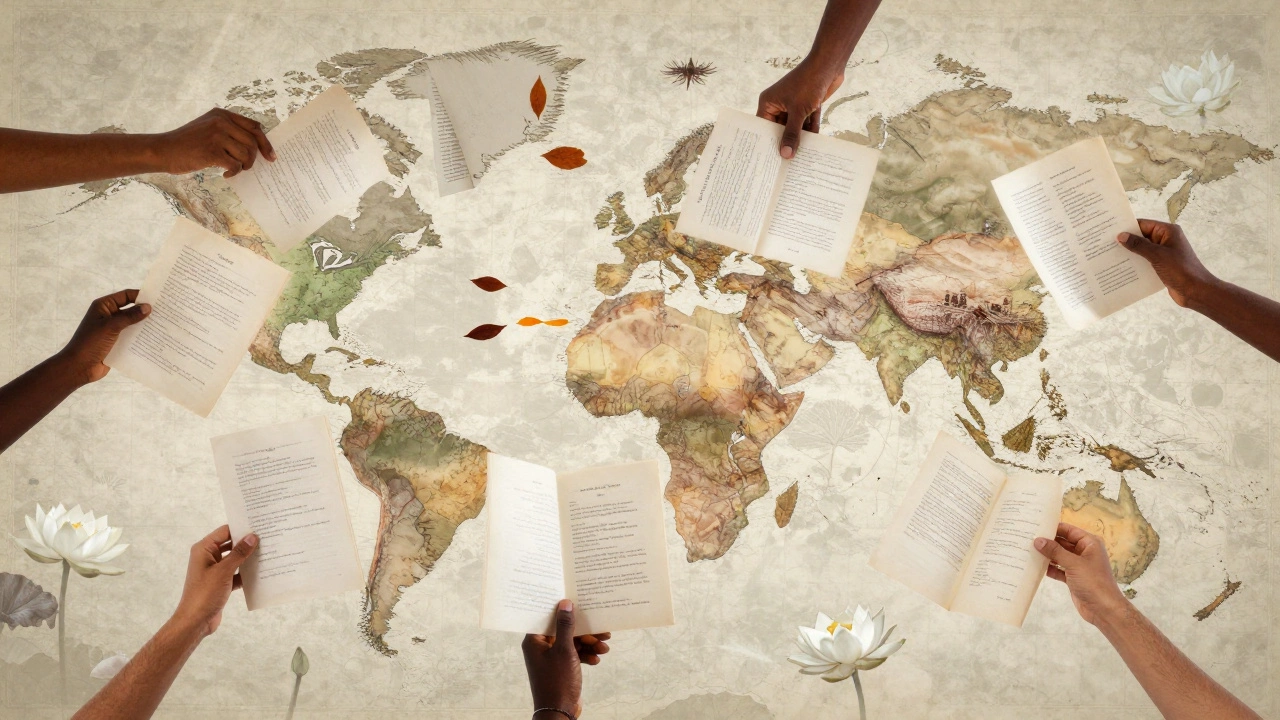
Ask a student in Berlin, a teacher in Lagos, or a poet in Tokyo to name an Indian English poet. Nine times out of ten, they’ll say Tagore. His poems are still taught in schools from Nairobi to New Zealand. His lines appear in wedding cards, funeral programs, and protest signs. His voice is used in films, music, and even meditation apps.
In India, his poetry is everywhere. People quote him without knowing he wrote in English. His lines are carved into school walls, printed on tea mugs, whispered in prayer. He’s not just a poet-he’s part of the country’s emotional DNA.
Modern Indian poets writing in English-Arundhathi Subramaniam, Jeet Thayil, or Arvind Krishna Mehrotra-often cite him as their starting point. They don’t imitate him. They build on the space he opened. He made it possible for Indian voices to be heard in English without losing their roots.
Why This Matters Beyond Poetry
Tagore’s success wasn’t just literary. It was political. At a time when colonial powers claimed Western culture was superior, he proved that Indian thought could be just as profound, just as universal. He didn’t fight with weapons-he fought with words. And he won.
His poetry shows that culture doesn’t need to be exoticized to be powerful. You don’t need to perform tradition to be authentic. You just need to speak your truth clearly, simply, and from the heart.
That’s why, over a century later, when someone asks who the most famous Indian English poet is, there’s only one answer. No debate. No runner-up. Just one name, echoing across borders, languages, and generations.
Where to Start Reading His English Poetry
If you’ve never read Tagore in English, begin here:
- Gitanjali (Song Offerings) - His Nobel-winning collection. Start with poems 1, 35, 71, and 85.
- The Gardener - A series of love poems, tender and raw.
- Stray Birds - Short, one-line poems that feel like proverbs from another world.
- Fireflies - A collection of reflections on life, death, and nature.
Read slowly. Let the silence between lines breathe. Don’t look for meaning-look for feeling.
Is Rabindranath Tagore the only famous Indian poet who wrote in English?
No, but he’s the only one whose work reached global fame and shaped how the world views Indian literature. Others like Sarojini Naidu, Nissim Ezekiel, and A.K. Ramanujan are important, but none matched his international recognition or lasting cultural influence.
Did Tagore write all his poems in English?
No. He wrote nearly all his poetry in Bengali. He translated a selection of his own poems into English, most notably Gitanjali. These translations were not literal-they were artistic reworkings, shaped to resonate with English readers while keeping the soul of the original.
Why is Tagore more famous than other Indian poets in English?
Tagore’s poetry speaks to universal human experiences-love, loss, spirituality, nature-without relying on Western references. His voice was original, quiet, and deeply rooted in Indian philosophy, yet accessible to anyone. He didn’t write to impress the West; he wrote to connect with the world.
Can I find Tagore’s poetry online for free?
Yes. Most of his English translations are in the public domain. You can find complete collections on Project Gutenberg, Internet Archive, and the Tagore Web Portal hosted by Visva-Bharati University. Many of his poems are also available on poetry websites and apps.
Are there any modern Indian poets who write like Tagore?
No one writes exactly like him. His voice was unique. But poets like Arundhathi Subramaniam and Jeet Thayil carry forward his spirit-blending spirituality with everyday language, using simplicity to express depth. They don’t copy him; they continue the tradition he started.
Final Thought
Tagore didn’t write poetry to be famous. He wrote because he had to. He wrote for the child who cried at sunset, for the old man who remembered his mother’s voice, for the stranger who felt alone in a crowded room. That’s why his words still matter. Not because they’re perfect. But because they’re true.