
Discover Your Gita Path
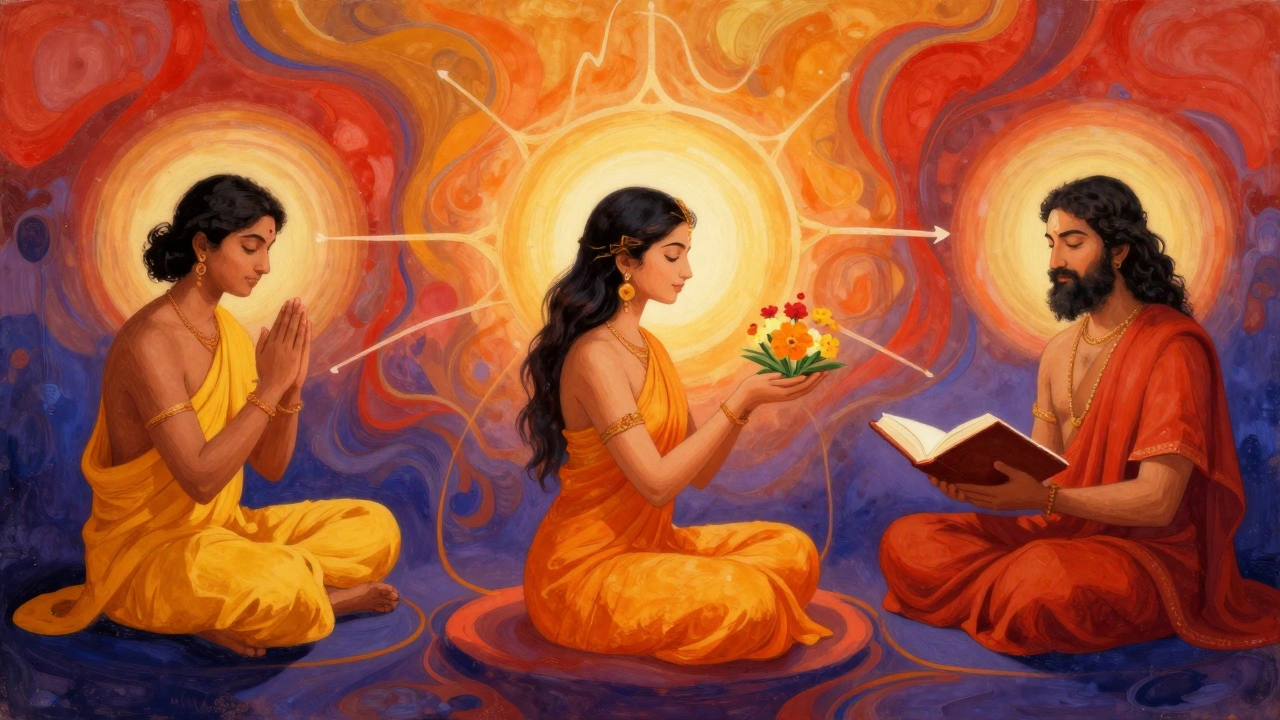
The Bhagavad Gita outlines three distinct paths to spiritual growth. Click on the path that resonates most with your current lifestyle and mindset to see how it applies to modern life.
Karma Yoga
The Path of Action
Focus: Duty and work without attachment to results.
Ideal for professionals, parents, and active individuals.
Bhakti Yoga
The Path of Devotion
Focus: Love, emotion, and surrender to the Divine.
Ideal for emotional seekers, artists, and lovers.
Jnana Yoga
The Path of Knowledge
Focus: Intellect, discernment, and philosophical inquiry.
Ideal for scholars, thinkers, and philosophers.
Modern Application
Key Challenge
Your Mantra
"..."
Imagine standing on a battlefield, weapons in hand, facing your own teachers and cousins. You are paralyzed by duty versus morality. This isn't a scene from a movie; it is the exact situation Arjuna, a central figure in Hindu mythology, found himself in during the Kurukshetra War. He dropped his bow, confused and overwhelmed. In that moment of crisis, he asked his charioteer, Krishna, for guidance. The conversation that followed became the Bhagavad Gita, one of the most influential spiritual texts in history.
If you have ever searched for "the famous mantra of Gita," you might be expecting a single Sanskrit chant like "Om Namah Shivaya." But the Gita doesn’t offer a simple sound to repeat. Instead, its core teaching-a philosophical mantra-is about how to act in life without being crushed by anxiety over outcomes. It is a practical guide to mental stability in a chaotic world.
The Core Teaching: Nishkama Karma
The most famous instruction from the Bhagavad Gita is found in Chapter 2, Verse 47. It is often cited as the essence of the entire text. Krishna tells Arjuna:
"You have a right to perform your prescribed duties, but you are not entitled to the fruits of your actions. Never consider yourself to be the cause of the results of your activities, nor be attached to inaction."
In Sanskrit, this concept is known as Nishkama Karma, which translates to action without desire for reward. This is not just religious dogma; it is a psychological strategy for high performance and peace of mind.
Think about your last big project at work or an important exam. Did you sleep well? Probably not, because you were obsessed with the result-getting the promotion or passing the test. That obsession created stress, which likely hindered your performance. The Gita’s mantra suggests that if you focus entirely on the quality of your effort and detach yourself from the outcome, you will perform better and suffer less anxiety.
This teaching addresses a universal human problem: the fear of failure. By shifting your identity from "someone who must succeed" to "someone who performs their duty with excellence," you remove the paralyzing weight of expectation.
Why There Is No Single "Chant" Mantra
Many people look for a Gita mantra to chant for protection or luck. While there are hymns within the Gita, such as the Shanti Mantra (peace mantra) used at the beginning and end of chapters, the text itself emphasizes understanding over repetition.
Krishna does not give Arjuna a spell to cast. He gives him a new way of thinking. The "mantra" is intellectual and behavioral. It requires you to change how you view your relationship with work, success, and failure. If you treat the Gita merely as a source of mystical sounds, you miss its primary value as a manual for living.
However, some devotees do recite specific verses. For example, Chapter 18, Verse 66 is often called the "Charama Shloka" or the ultimate verse. It reads: "Abandon all varieties of dharma and simply surrender unto Me alone. I shall liberate you from all sinful reactions; do not fear." This is more of a prayer of surrender than a daily operational mantra for decision-making.
The Three Paths to Spiritual Growth
The Bhagavad Gita outlines three main paths (Yogas) to achieve spiritual balance. Understanding these helps clarify why the "action" path is so prominent for modern readers.
| Path (Yoga) | Focus | Best For | Key Challenge |
|---|---|---|---|
| Karma Yoga | Action without attachment | Professionals, parents, active individuals | Controlling ego and desire for credit |
| Bhakti Yoga | Devotion and love for the Divine | Emotional seekers, artists | Maintaining consistency in devotion |
| Jnana Yoga | Knowledge and discernment | Scholars, philosophers, thinkers | Overcoming intellectual pride |
For most people living in the modern world, Karma Yoga is the most applicable "mantra." We cannot all retreat to caves for meditation (Jnana Yoga) or dedicate every waking hour to temple service (Bhakti Yoga). We have jobs, bills, and families. Karma Yoga teaches us how to sanctify our daily work.

Applying the Gita's Wisdom to Modern Life
You don't need to be a warrior or a monk to use the Gita's teachings. Here is how you can apply the concept of detachment to everyday scenarios.
- In Career: Focus on delivering excellent work today. Do not spend energy worrying about whether your boss noticed it or if you will get a raise next month. The raise is outside your control; your effort is not.
- In Relationships: Love your family and friends fully, but accept that they are independent beings with their own choices. You cannot force someone to change or stay. Attachment leads to suffering when things go wrong; acceptance brings peace.
- In Health: Follow your diet and exercise routine diligently. However, do not become anxious if you don't see immediate results on the scale. Trust the process rather than obsessing over the metric.
This approach reduces burnout. When you tie your self-worth to external results, you are fragile. A bad review or a failed project feels like a personal attack. When you tie your self-worth to your integrity and effort, you become resilient. You know you did your best, regardless of the outcome.
The Role of Dharma (Duty)
A crucial part of the Gita's message is Dharma, or righteous duty. Krishna argues that Arjuna must fight because it is his duty as a warrior to protect justice. He shouldn't run away out of fear or pity.
This raises a difficult question: What is your dharma? In modern terms, this means identifying your responsibilities based on your role in society. Are you a parent? Then nurturing your children is your dharma. Are you a leader? Then guiding your team ethically is your dharma.
The Gita warns against abandoning your duty. Laziness disguised as "detachment" is not spiritual. True detachment means doing your job with full intensity but letting go of the need for applause. It is active engagement with emotional freedom.
Common Misconceptions About the Gita
There are several myths surrounding the Bhagavad Gita that prevent people from benefiting from its wisdom.
Myth 1: It promotes violence.
Critics often point to the battlefield setting and accuse the Gita of encouraging war. However, the war is symbolic. It represents the internal battle between good and evil impulses within every human heart. Arjuna's struggle is yours: the conflict between doing what is easy (running away) and what is right (facing challenges).
Myth 2: It is only for Hindus.
While rooted in Indian culture, the principles of psychology, ethics, and leadership in the Gita are universal. Leaders like Mahatma Gandhi, Swami Vivekananda, and even Albert Einstein have drawn inspiration from it. Its lessons on stress management and ethical action apply to anyone, regardless of religion.
Myth 3: It is too complex to read.
The original Sanskrit is dense, but many modern translations make it accessible. You don't need to read all 700 verses at once. Start with Chapter 2 (Sankhya Yoga), which lays the foundation, and Chapter 18 (Moksha Sannyasa Yoga), which summarizes the key takeaways.
How to Start Practicing the Gita's Mantra
If you want to integrate this philosophy into your life, start small. You don't need to meditate for hours. Try this simple practice:
- Identify one task that is causing you anxiety because of the potential outcome.
- Break it down into actionable steps you can control right now.
- Perform those steps with full attention and care.
- Consciously release the worry about the result. Remind yourself: "I have done my part. The rest is not mine to control."
Repeat this daily. Over time, you will notice a shift. You will feel lighter, more focused, and less reactive to setbacks. This is the power of the Gita's true mantra: inner freedom through disciplined action.
Is there a specific Sanskrit mantra in the Bhagavad Gita?
While there are no "magic" mantras for luck, the text contains powerful verses. The most famous is Chapter 2, Verse 47, which teaches detachment from results. Another popular one is Chapter 18, Verse 66, which encourages total surrender to the divine. These are meant to be meditated upon, not just chanted.
Who wrote the Bhagavad Gita?
The Bhagavad Gita is part of the epic Mahabharata, traditionally attributed to the sage Vyasa. It is presented as a dialogue between Prince Arjuna and Lord Krishna, who serves as his charioteer and spiritual guide.
Can non-Hindus benefit from reading the Gita?
Absolutely. The Gita deals with universal themes like duty, ethics, mental health, and leadership. Many secular leaders and psychologists recommend it for its insights into managing stress and making ethical decisions under pressure.
What is the difference between Karma Yoga and other yogas?
Karma Yoga focuses on selfless action. Bhakti Yoga focuses on devotion and love, while Jnana Yoga focuses on intellectual knowledge and discrimination. Karma Yoga is often considered the most practical for people engaged in daily professional and social life.
Why is Chapter 2 of the Gita so important?
Chapter 2, known as Sankhya Yoga, sets the foundation for the entire text. It introduces the concept of the eternal soul (Atman), explains why death is not the end, and presents the core teaching of Nishkama Karma (action without attachment to results).