Indian Household Wealth Composition Calculator
Drag to adjust:
Asset Breakdown
Cash + Deposits + Stocks (excluding property/gold)
Wealth Profile Analysis
Enter a value to see your wealth profile analysis based on typical Indian household distributions.
When you hear "average," you probably picture a single number that represents everyone. You imagine a middle-class family in a mid-sized city with a modest home and some savings. But if you actually calculate the average wealth of an Indian using simple math, the result is wildly misleading. It’s like saying the average height of a room full of toddlers and NBA players is six feet tall. The reality is skewed by extreme outliers.
To understand what money really looks like for people living in India today, we have to look past the headline figures. We need to talk about the median-the person right in the middle-and how assets are distributed across urban apartments, rural land, and digital wallets. This isn't just about banking statistics; it's about understanding the economic fabric of the world's most populous nation as we move through 2026.
The Difference Between Mean and Median Wealth
If you take the total value of all assets in India-homes, gold, stocks, cash, and business equipment-and divide it by the population, you get the "mean" or average. Recent estimates from major credit rating agencies like CRISIL place this figure quite high, often exceeding $150,000 per adult. That sounds impressive, doesn't it? It suggests that the typical Indian is wealthy.
But here is the catch: a tiny fraction of Indians hold a massive portion of that wealth. The top 1% owns nearly half of the country's total assets. When you include billionaires and large industrialists in the calculation, they pull the average up dramatically. For the vast majority of people, their personal net worth is nowhere near that average.
This is why economists prefer the median wealth. The median tells you where the 50th percentile sits. If you line up every Indian from poorest to richest, the median is the person standing exactly in the middle. According to data from the World Inequality Database and recent surveys by the Reserve Bank of India (RBI), the median net worth of an Indian household is significantly lower, often hovering around $3,000 to $5,000 USD depending on whether you count informal assets like livestock or agricultural tools.
Where Does Indian Wealth Actually Live?
In the United States or Europe, wealth is heavily tied to stock markets and retirement funds. In India, the story is different. The composition of household balance sheets reveals unique cultural and structural preferences.
| Asset Class | Approximate Share of Total Wealth | Key Characteristics |
|---|---|---|
| Real Estate | 40-50% | Homes, plots, commercial property. Illiquid but culturally valued. |
| Gold & Jewelry | 20-25% | Cultural safety net. Held physically in homes or banks. |
| Financial Assets | 15-20% | Savings accounts, PPF, mutual funds, equities. Growing rapidly. |
| Physical Durables | 5-10% | Vehicles, electronics, furniture. |
| Cash & Deposits | 5-10% | Liquid cash, fixed deposits. |
Real estate remains the king of Indian wealth. Unlike Westerners who might invest heavily in 401(k)s or IRAs, Indians traditionally buy land and build homes. This serves dual purposes: it provides shelter and acts as a store of value. However, real estate is illiquid. You can't sell a bedroom during an emergency. This creates a paradox where many families appear "asset-rich" on paper but are "cash-poor" in daily life.
Gold plays a similarly critical role. It is not just jewelry; it is insurance. In times of crisis, gold is melted down or pledged for loans. While digital gold platforms have grown, physical possession still dominates trust among the mass market.

The Urban-Rural Divide
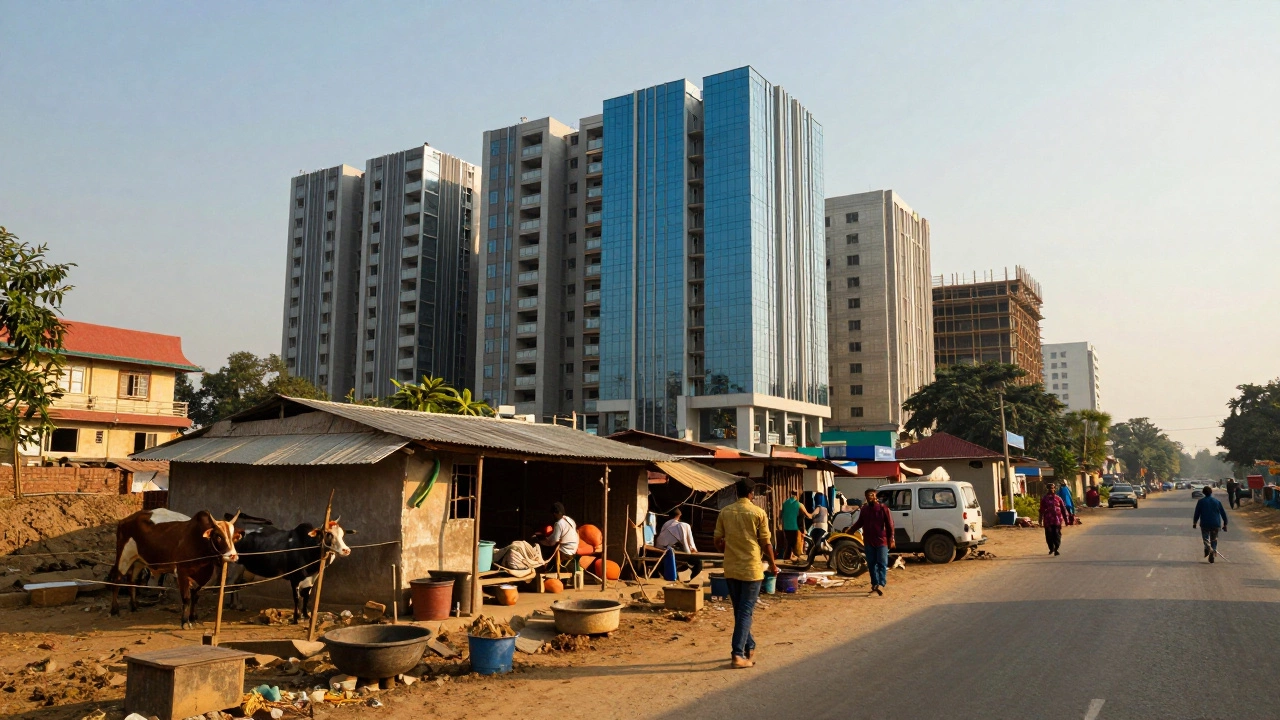
You cannot discuss Indian wealth without addressing the geographic split. The gap between a resident of Mumbai or Bangalore and a farmer in Bihar is stark, though it is narrowing due to digital penetration.
Urban households generally have higher access to formal financial products. They are more likely to own equity shares, participate in pension schemes, and have health insurance. Their wealth is increasingly diversified. An urban professional in their thirties might have a mix of mutual funds, a down payment on an apartment, and a significant amount in their Unified Payments Interface (UPI) linked bank accounts.
Rural wealth, on the other hand, is often tied to agriculture and informal labor. Assets include tractors, cattle, and small plots of land. While the income volatility is higher in rural areas, the cost of living is also lower. Furthermore, government subsidy programs and direct benefit transfers have increased liquidity in rural pockets, allowing for greater consumption and small-scale investment.
The rise of fintech has blurred these lines. Apps that allow micro-investing in stocks or fractional ownership of gold have brought financial instruments to tier-2 and tier-3 cities. This democratization of finance is shifting the median wealth trajectory upward for millions who were previously excluded from formal markets.
The Rise of the Young Investor
A major shift happening in 2026 is the behavior of young Indians. Born into a period of rapid digitization, this demographic does not view wealth accumulation the same way their parents did. They are less obsessed with buying physical gold and more focused on liquid, growth-oriented assets.
Mutual funds and direct equity trading have seen explosive growth. The National Stock Exchange (NSE) and Bombay Stock Exchange (BSE) report record numbers of new demat accounts opening every month. These investors are comfortable using apps to track portfolios, trade cryptocurrencies (where regulated), and save via Systematic Investment Plans (SIPs).
This behavioral change is crucial. As this generation ages, the structure of Indian wealth will likely pivot from brick-and-mortar dominance to a more balanced portfolio including equities and bonds. This transition increases the overall efficiency of capital in the economy but also exposes younger households to market volatility.

Debts and Liabilities: The Hidden Side
Wealth is not just what you own; it is what you own minus what you owe. Historically, Indian households had very low debt levels compared to global averages. Home loans were rare, and consumer credit was limited. This conservative approach provided stability but also constrained spending power.
That is changing fast. Personal loans, credit cards, and especially housing loans are becoming mainstream. While this allows families to upgrade lifestyles earlier, it also introduces risk. High-interest unsecured debt can erode net worth quickly. Financial literacy campaigns are struggling to keep pace with the availability of credit, leading to instances of over-leverage among salaried employees.
However, even with rising debt, the net worth of the median Indian remains positive. Most households prioritize asset acquisition over excessive borrowing. The culture of saving-often driven by necessity rather than choice-still prevails.
Factors Shaping Future Wealth Trajectories
Looking ahead, several macroeconomic factors will determine how the average Indian's wallet grows:
- Demonetization Legacy: The push toward a cashless economy has formalized transactions, bringing more income into the taxable net and increasing transparency.
- Gig Economy Growth: Millions are moving from traditional employment to gig work. While flexible, this often lacks employer-sponsored benefits like pensions, placing the burden of wealth creation entirely on individual savings habits.
- Inflation Rates: Persistent inflation eats away at cash savings. Those who remain in fixed deposits or under mattresses lose purchasing power. Investing in inflation-beating assets becomes essential.
- Government Schemes: Initiatives aimed at housing for all and financial inclusion continue to lift the floor for the lowest income brackets.
The convergence of these trends suggests that while inequality remains a challenge, the absolute standard of living for the median Indian is improving. The definition of wealth is expanding beyond mere accumulation to include access to services, healthcare, and education.
Is the average Indian rich?
Statistically, the "average" (mean) appears high due to billionaires skewing the data. However, the median Indian has a modest net worth, primarily tied to real estate and gold. Most Indians are working towards financial stability rather than existing in wealth abundance.
What is the biggest asset for Indian households?
Real estate is the largest component of household wealth in India, accounting for nearly half of total assets. This includes primary residences, vacant plots, and commercial properties owned by families.
How does gold fit into Indian wealth?
Gold represents approximately 20-25% of household wealth. It serves as a cultural tradition, a hedge against inflation, and a liquid safety net during emergencies. Physical gold bars and jewelry dominate this category.
Are Indians investing more in the stock market?
Yes, there has been a surge in retail participation in equity markets. Younger demographics are increasingly using mutual funds and direct stock trading apps, diversifying away from traditional physical assets like gold and land.
What is the difference between mean and median wealth in India?
The mean wealth is pulled up by the ultra-wealthy, giving a falsely high impression of general prosperity. The median wealth represents the actual financial position of the person in the middle of the population, which is much lower and more reflective of everyday reality.