
Blogging Income Strategy Calculator
Required Volume
Quick Wins for Your Passive Income Journey
- Focus on 'Evergreen' Content: Write guides that will be as relevant in 2029 as they are in 2026.
- Diversify Revenue: Don't rely on one ad network; combine ads, affiliates, and digital products.
- Prioritize High-Intent Keywords: Target people looking to buy a solution, not just those looking for a free definition.
- Build an Email List: Your traffic is a loan from Google; your email list is an asset you own.
Picking a Niche That Actually Pays
You can't make $1,000 a month writing about your daily breakfast. To hit that number, you need a niche where people are already spending money. The most profitable niches usually fall into three buckets: Health, Wealth, and Relationships. For example, a blog about "Budgeting for Gen Z" has a higher earning potential than "My Favorite Clouds" because there are specific financial tools (banks, apps) that will pay you to recommend them.
When picking your topic, look for the "Commercial Intent." If you find that there are dozens of software tools or physical products with a monthly subscription price of $20 or more, you've found a goldmine. A niche with high CPM (Cost Per Mille) means advertisers are willing to pay more for every 1,000 views your site gets, which drastically shortens your path to $1,000.
The Power of Affiliate Marketing
This is often the fastest way to reach your goal. Affiliate Marketing is a performance-based marketing strategy where a blog owner earns a commission for promoting a third-party product. Instead of waiting for pennies from ads, you earn a percentage of a sale. If a product pays a $50 commission, you only need 20 sales a month to hit $1,000.
The secret here is not to "sell," but to "recommend." Create "Best [Product] for [Specific Person]" lists. For instance, instead of a generic "Best Laptops" post, try "Best Laptops for Architecture Students in 2026." This attracts a specific buyer who is ready to spend. When you provide a genuine comparison based on real usage, the trust you build converts readers into buyers far more effectively than a pushy sales pitch.
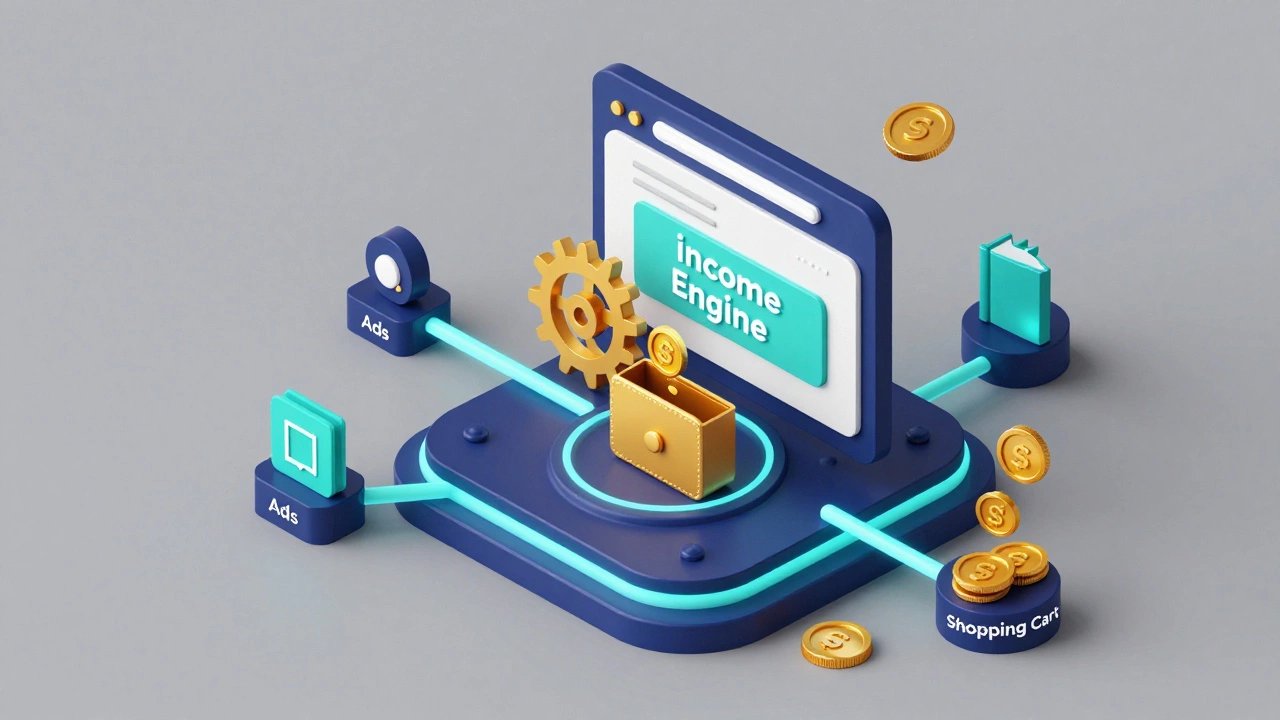
Scaling with Ad Networks
Ads are the definition of passive. Once the code is on your site, you just need traffic. However, not all ad networks are equal. Starting with Google AdSense is common, but the payouts are often low. To truly hit $1,000, you want to move toward premium networks like Mediavine or Raptive.
| Method | Effort to Setup | Passive Level | Income Potential |
|---|---|---|---|
| Display Ads | Low | High | Medium (Scales with traffic) |
| Affiliate Links | Medium | Medium | High (High margins) |
| Digital Products | High | High | Very High (100% profit) |
| Sponsored Posts | Low | Low (Requires active negotiation) | Medium |
Creating Your Own Digital Products
If you want to stop relying on other companies, create your own. An E-book, a mini-course, or a set of templates is a passive income blogging powerhouse. Once the product is created, the cost of selling one more copy is zero. If you sell a $25 guide on "How to Start a Garden in Small Apartments," you only need 40 sales a month to hit your $1,000 goal.
The most successful digital products solve a specific, painful problem. Don't write a general book on "Fitness." Instead, write a "30-Day Post-Pregnancy Strength Plan." By narrowing the focus, you increase the value of the solution, allowing you to charge more while spending less on acquiring a lead.

Mastering SEO for Long-Term Traffic
Traffic is the fuel for your passive income engine. Without it, your affiliate links are just dead text. Search Engine Optimization (SEO) is the practice of optimizing a website to rank higher in search engine results pages (SERPs). To make money passively, you need to rank for "long-tail keywords." These are longer, more specific phrases that have less competition.
For example, "make money online" is too competitive. But "how to make money blogging about sustainable fashion" is a specific query. People searching for that are much more likely to stay on your page and click your recommendations. Use tools to find keywords where the "Keyword Difficulty" is low but the "Search Volume" is steady. This ensures a slow but steady stream of visitors without you having to post every single day.
The "Set it and Forget it" Fallacy
Here is the truth: passive income is not "no work." It is "front-loaded work." You spend six months writing 50 high-quality articles, optimizing them for SEO, and setting up your email funnels. After that, you might only spend 2-4 hours a week updating old links or checking your analytics. The "passive" part kicks in after the foundation is solid.
One common mistake is ignoring content decay. A post from 2024 might stop ranking in 2026 because the information is outdated. To keep the $1,000 flowing, spend one day a month auditing your top-earning posts. Update the dates, refresh the statistics, and ensure the products you're recommending are still in stock. This small effort prevents your income from dipping.
How long does it take to make the first $1,000?
For most bloggers, it takes between 6 to 18 months. This depends on your niche and how aggressively you optimize for SEO. Those who focus on high-ticket affiliate products usually hit the mark faster than those relying solely on ads.
Do I need a lot of traffic to earn $1,000 a month?
Not necessarily. If you use display ads, you might need 50,000+ visitors. However, if you sell a $100 product or promote a high-paying affiliate offer, you could reach $1,000 with as few as 2,000 targeted visitors.
Which is better: Ads or Affiliate Marketing?
They serve different purposes. Ads are great for high-volume, general-interest blogs. Affiliate marketing is better for "review" or "tutorial" style blogs where the reader is in a buying mindset. The most successful blogs use both.
Can I start a blog for free and still make money?
You can start for free, but it's hard to monetize. Free platforms often don't allow you to place your own ads or control your SEO. Spending a small amount on your own domain and hosting gives you full ownership and professional credibility.
What happens if Google updates its algorithm?
Algorithm updates can cause traffic dips. This is why building an email list is critical. If your Google traffic drops, you can still send a newsletter to your subscribers to drive sales to your affiliate products or digital offers.
Next Steps to Get Started
If you're starting from scratch, don't try to do everything at once. First, spend one week researching your niche and finding 20 "low-hanging fruit" keywords. Next, set up a simple website and write your first 10 pieces of evergreen content. Focus on helping the reader solve a problem first; the money follows the value you provide. Once you see your first few visits in Google Search Console, start adding affiliate links and exploring ad networks.